The Autechre Dialect: An A–Z for Fans Who Have Nodded Along Too Long
Every scene has a dialect. Autechre's is more encrypted than most: part Warp catalogue shorthand, part forum in-joke, part software manual. If you have ever scrolled a UK electronic-music thread and quietly wondered what on earth a 'Perlence range' is, this one is for you. It is not a gate, just a glossary.
A–F: The Foundations
A is for AE_LIVE. The official live series, rolled out in batches, is the easiest way to hear how far the duo will push a room. Start with AE_LIVE 2016/2018 if you want the modern language in full flight.
B is for Booth. Sean Booth, one half of Autechre and a reliable source of dry, cryptic interviews. Fans quote his remarks the way other scenes quote lyrics.
C is for Confield. The 2001 album that split the audience and then slowly became the benchmark. Listen on headphones first; a Manchester night bus is not the place for 'Pen Expers'.
D is for Draft 7.30. The 2003 follow-up, all brittle rhythms and strange air. 'Xylin Room' is the friendly door in.
E is for elseq. The sprawling 2016 five-volume release. Treat it like a box of unlabelled tapes: dip in, take notes, do not try to 'finish' it in one sitting.
F is for Foldfree Casual. A track title that doubles as a fan mood. It is from elseq 1, and it is a useful reminder that Autechre titles are often better read as textures than clues.
G–M: The Deep Cuts
G is for Gescom. The loose collective around the duo, responsible for some of the most collectable and confusing records in the wider family tree. Charity-shop hunters, keep an eye out.
H is for Hafler Trio. The duo's collaborations with the Hafler Trio are not casual listening, but they are essential context for anyone tracing Autechre's interest in installation, atmosphere and uncomfortable rooms.
I is for Incunabula. The 1993 debut. Still the most approachable entry point, and still a record that sounds like a city at 4am rather than a software demo.
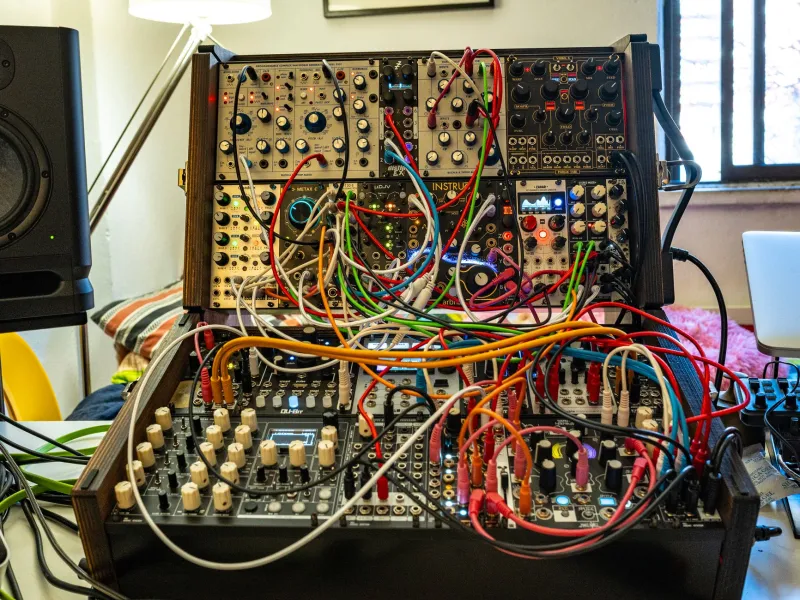
J is for Jitter. Not a track, but the visual side of Max/MSP. It turns up in fan chatter about the duo's patch-building world, and it explains a lot of the 'how did they make that' energy.
K is for Keyosc. A deep NTS Sessions cut. If you have a decent pair of speakers, this is one of those tracks that makes the room feel larger than it is.
L is for L-event. The 2013 EP. Short, sharp and a good way to test whether you prefer Autechre in bite-sized portions or full-length sprawl.
M is for Max/MSP. The software name that gets dropped whenever someone wants to sound knowledgeable. In practice, it is just part of the toolkit: a way of building systems, not a magic wand.
N–S: The Modern Vocabulary
N is for NTS Sessions. The 2018 eight-hour radio residency turned release. Do not treat it as a test of endurance. Treat it as a place to live for a week.
O is for Oversteps. The 2010 album that surprised people by sounding almost warm. 'See on See' is the obvious way in, and there is no shame in that.
P is for Perlence. A Quaristice track with a whole family of variants. If a thread mentions 'Perlence range', it is talking about the duo's habit of stretching one idea across multiple versions.
Q is for Quaristice. The 2008 album, released in several versions and edits. Collectors argue about the best sequence; listeners should just pick one and let it unfold.
R is for Rae. A LP5 track and a fan favourite for good reason. It is melodic, melancholy and proof that Autechre can do 'pretty' without losing the plot.
S is for Sublimit. The track from Amber, and the name of this site. It is a useful reminder that the duo's early ambient side never really disappeared; it just got buried under sharper rhythms.
T–Z: The Collector's End
T is for Tri Repetae. The 1995 album that many UK fans treat as the sacred text. 'VLetrmx21' aside, it is the record that made the duo's reputation as builders of strange machines.
U is for Untilted. The 2005 album with a title that fans still pronounce with a knowing pause. Dense, twitchy and best approached as a whole.
V is for VLetrmx21. A track that has become shorthand for the duo's emotional register. If someone says they want 'the sad one', this is often what they mean.
W is for Warp. The label that has housed Autechre for most of their career. In UK terms, Warp is not just a logo; it is a family tree that runs through Sheffield, London and beyond.
X is for Xylin Room. A Draft 7.30 highlight and a good example of how the duo can make a rhythm feel like a room you are walking through.
Y is for YJY UX. An elseq track that rewards patience. It is the kind of title that looks like a typo until you hear the way it moves.
Z is for Zeiss Contarex. A Confield track and a perfect full stop for this list: obscure, precise and just a little bit intimidating. Much like the catalogue itself.
None of this is gatekeeping. It is just the vocabulary that builds up around any long-running project, especially one as detailed as Autechre's. Learn a few terms, play a few records, and the threads start to make sense. In 2026, with the catalogue still growing and the forums still arguing, that is probably the best way in.