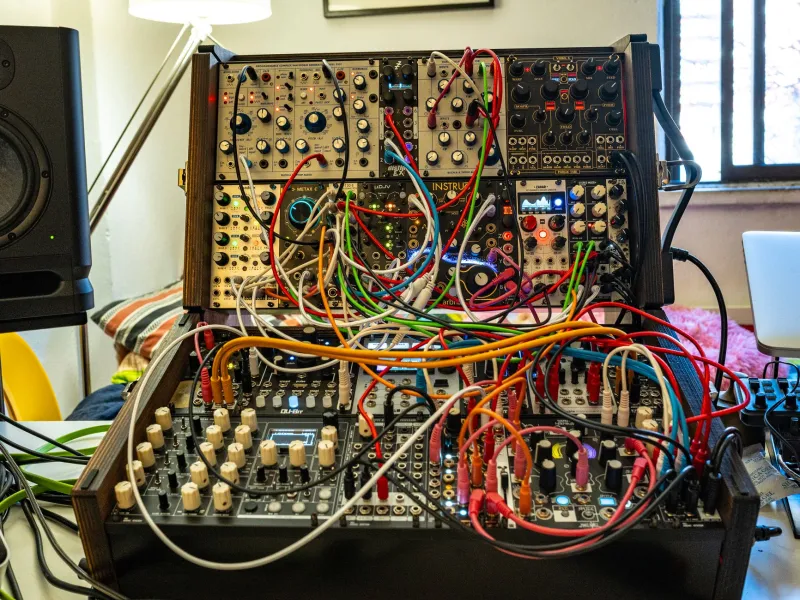
Desk Job Decibels: Ranking Autechre for Open-Plan Survival
Photo: Neil Owen , CC BY-SA 2.0, via Wikimedia Commons
There is a particular kind of silence in a UK open-plan office. It is not silence. It is the kettle, the printer, someone saying sorry, you are on mute, and a low-grade hum that seems to come from the building itself. Into this environment we bring Autechre, a band whose music can either build a useful wall around your attention or make a colleague lean over and ask if your laptop is broken. This is a guide to the former.
The criteria: what makes Autechre office-friendly?
Autechre are not background music in the way a playlist of ambient pads is background music. Their tracks often have no vocals, which helps, but they also have irregular rhythms, sudden textural shifts and sub-bass that can travel through a desk. The office-friendly Autechre track tends to have a steady pulse, a warm or neutral tone, and no moment that makes a nearby head turn. The office-hostile track is dense, jagged, very long, or built around high-frequency chatter that sounds like a fault in the building.
Volume etiquette matters more than album choice. Closed-back headphones are non-negotiable. If your headphones leak, your colleagues are effectively listening to Autechre too, and they did not opt in. Keep the level just above the office hubbub, not so loud that you miss the fire alarm. Noise-cancelling can help with the kettle and the chat, but it can also flatten the low end that makes Autechre interesting, so use it with care.
Tier one: albums that melt into the background
Amber (1994) is the safest bet in the catalogue. It is warm, dubby and long-form, with tracks like Montreal and Nine sitting comfortably under conversation. The beats are there, but they do not demand attention. It masks the printer and the kitchen debrief without becoming a talking point.
Oversteps (2010) is another strong choice. It is melodic and spacious, with more air around the sounds than the denser 2000s records. Tracks such as r ess and see on see have a calm, almost geometric quality that suits spreadsheet work and low-level admin. It is not invisible, but it is polite.
SIGN (2020) works well for the same reason. It is slow, atmospheric and less percussive than much of their output. M4 Lema and F7 create a room inside your headphones without filling the room around your desk. This is the one for a Monday morning when the office is still waking up.
Tier two: steady, with a pulse
Incunabula (1993) has enough early-techno momentum to keep you moving through a dull afternoon, but it is not aggressive. Bike and Eggshell are rhythmic without being shouty. It is a good compromise if you need energy but cannot risk a track that sounds like a malfunction.
Tri Repetae (1995) is mechanical and steady. Dael and Clipper have a relentless but even quality that suits repetitive tasks. It is less warm than Amber, so it will not hide the office noise as effectively, but it will not startle anyone either.
Quaristice (2008) is a mixed bag for the office because it jumps between short sketches and longer pieces. Altibzz is beautifully calm and will disappear into the background. Other tracks are more restless. Treat it as a playlist you curate rather than an album you leave running.
Tier three: headphones only, focus required
LP5 (1998) is where the office guide starts to split. Acroyear2 and 777 are intricate and rewarding, but they ask for attention. If you are doing deep work and can afford to be slightly less present in the room, this is a good choice. If you are on a call or waiting for a manager to tap your shoulder, leave it for later.
Chiastic Slide (1997) is dense and detailed. Cipater and Tewe are brilliant, but they have a lot going on. They are more likely to pull you out of a task than to carry you through it.
Exai (2013) is a long, complex record with several tracks that work at low volume and several that do not. Fleure and irlite (get 0) are manageable. bladelores is a beautiful piece of music, but it is also eleven minutes of slow-building density that will make you forget where you are.
Tier four: question magnets
Confield (2001) is a masterpiece and a terrible office album. VI Scose Poise, Pen Expers and Sim Gishel are alien, glitchy and full of sounds that colleagues will interpret as computer failure. This is not a criticism of the music. It is a warning about the social cost.
Draft 7.30 (2003) is similarly jagged. Xylin Room and 6IE.CR are thrilling on headphones at home, but in an open-plan office they invite the question, what are you listening to? That question is fine once. It is less fine every day.
Untilted (2005) is manic in places. LCC and Ipacial Section are superb, but they are not background. The same goes for the sprawling elseq 1-5 (2016) and NTS Sessions (2018). These are for dedicated listening, not for a shared desk.
The do-not-play-on-speaker list
This is strict. Do not play any of the following on a speaker in a shared space: Pen Expers, LCC, Gantz Graf, feed1, elyc6 0nset, bladelores, Ipacial Section and 1 1 is. The reasons vary. Some have sudden high-frequency bursts. Some are very long. Some have rhythms that sound like an alarm. All of them will make someone look up.
The three-question test
If a track prompts a colleague to ask what is this, is that a printer, or are you okay, it does not belong in your work playlist. This is not about whether the track is good. It is about whether it is good in this room, at this volume, with these people.
Autechre at work is not about showing taste. It is about building a small, private room inside your head while the office carries on around you. Keep it quiet, keep it closed-back, and keep the speaker off.