Patch Less, Listen More: Autechre’s Old Kit Lists and the UK Bedroom Studio in 2026
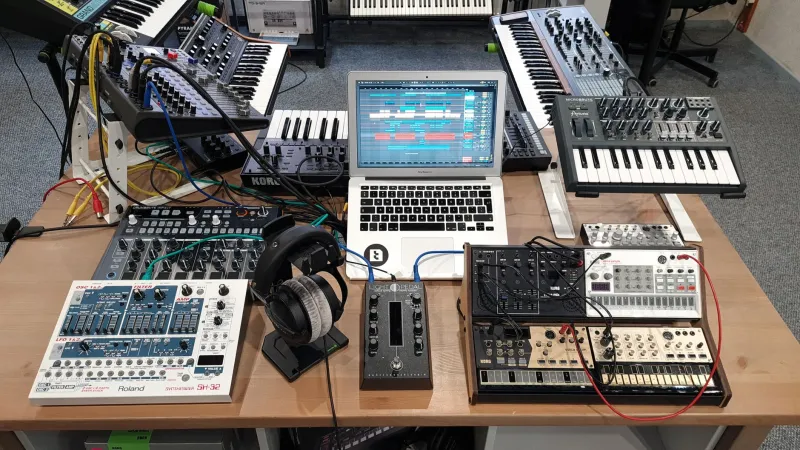
There is a particular kind of UK bedroom producer who keeps a Gumtree tab open the way other people keep a weather app. The flat is small, the desk is a shelf, the interface is held together by one reliable USB cable, and yet the mind is elsewhere: maybe a discontinued Elektron box, maybe a vintage drum machine with a voltage switch, maybe one more pedal that will finally make the room sound like a room. Autechre are dangerous for this mood. Their catalogue is so precise, so textural, so obviously the product of a system, that it is tempting to read every old interview as a parts list. It is not. The more useful reading is almost the opposite: their gear history is a record of constraints being turned into decisions.
The kit list is not the sound
Autechre’s early reputation was built on cheap, awkward equipment and a refusal to wait for better. Interviews and studio photos from the period point to drum machines, samplers, effects and whatever was within reach, often used in ways the manual did not encourage. Later periods bring Elektron machines, modular systems, Max patches and custom software, but the pattern stays the same. The interesting thing is not the model number. It is the routing: what feeds what, what gets resampled, what is allowed to distort, what is left alone. A cheap drum machine through a borrowed mixer and a cassette deck is not a lesser version of a famous setup. It is a system with its own behaviour.
That distinction matters in a UK flat more than it does in a gear forum. Most of us do not have a spare room. We have a corner, a pair of headphones, a landlord who does not want holes in the wall and a neighbour who can hear the low end through the floor. The question is not how to recreate a documented Autechre patch. It is how to build a patch that behaves interestingly within those limits. The answer is usually fewer things, routed more deliberately.
Small rooms reward strange routing
Autechre’s music often sounds like it was made by a system that is listening to itself. Feedback, auxiliary sends, resampling and unlikely chains do more work than a long list of instruments. You can test that idea with almost anything. Send a single drum hit through a cheap pedal, then through the interface, then back out and through the pedal again. Record the result. Change one cable. Record it again. That is not a tribute to Autechre; it is the same basic curiosity that makes their records feel alive.
In a small room, this approach is practical. You do not need a wall of synths to create depth. You need one source, one processor and one recorder, arranged so that each stage changes the next. A second-hand interface with stable drivers is more valuable than a collector’s item that hums. A boring mixer with usable aux sends will teach you more about texture than another plugin folder. If you are lucky enough to own a hardware sequencer, learn its odd corners before buying its replacement. The UK second-hand market in 2026 is full of gear that was bought for a project and sold when the project changed shape. That is fine. Buy repairable, buy boring, and keep the receipt.
There are practical UK-specific traps, too. Vintage gear from the US may need a transformer, and a damp flat is not kind to old circuit boards. Before you chase a rare machine, work out whether you can get it repaired locally and whether the power supply is sensible for a UK plug. Charity-shop finds are lovely when they happen, but they are not a studio strategy. The same goes for auction listings that describe every scratch as mojo. Autechre’s old gear was not precious. It was used.
The anti-hoarding patch
A useful exercise is to write a patch note instead of a wish list. Not a list of equipment, but a description of a signal path: source, processor, recorder, and the one decision that makes it interesting. Keep it to a single page. If the page fills up with gear you do not own, start again. The aim is not to clone a setup. It is to clone the decision-making: limit the inputs, make the routing do something slightly wrong, and record the result before you talk yourself out of it.
Autechre’s later work is often described as complex, but complexity is not the same as quantity. Max patches and modular systems can be enormous, yet the musical result often depends on a few rules repeating and interfering. A bedroom producer with one sampler and one effects unit can borrow that logic without borrowing the budget. Set a rule, break it once, record the evidence. That is a patch. It is also a way of finishing something.
What to actually buy in 2026
If you must buy, buy the thing that removes a friction point. A reliable audio interface. A pedal that does one odd thing well. A second-hand sequencer with a screen you can read. A sampler with enough memory for your own recordings. Avoid the collector tier unless you are genuinely collecting, and be honest about the difference. A vintage analogue synth at a 2026 collector price is not a shortcut to Autechre’s texture. It is a commitment to maintenance, space and insurance. A software instrument and a cheap controller can get you to the same question faster: what happens if I route this through that?
Listen to the routing, not the receipt
Autechre’s records are full of clues, but the clues are in the behaviour of the sound: how a hit folds into a tail, how a reverb seems to arrive before the note, how a rhythm keeps changing its mind. You can hear that on headphones in a small flat. You do not need the original machine to learn from it. The old kit lists are interesting because they show two people making do, then making a language out of making do. In 2026, with UK second-hand prices wobbling and flat space at a premium, that is the lesson worth keeping. Patch less. Listen more. Let the room, the cables and the one weird decision do the rest.