Preheat, Crackling, Washing-Up: A Sunday Roast Running Order for Autechre
A Sunday roast is not a single dish. It is a sequence: oven on, potatoes parboiled, meat rested, gravy rescued, plates warmed, washing-up avoided. Autechre's catalogue is also a sequence, even when it feels like a weather system. The useful link is not flavour or whimsy but texture, duration and mood. Pair the records to the timetable and the meal becomes a listening route. Ignore the timetable and you end up with Confield during the Yorkshire pudding lift, which is a mistake unless you enjoy burnt batter and mild panic.
Start with the oven, not the plate
Autechre are often discussed as a puzzle to be solved. A roast is a timetable to be survived. Put the two together and you get a practical argument: match the attack of the record to the job in hand. Crisp, quick records belong with high heat and short timers. Dense, savoury records belong with resting meat and reduction. Long, incremental records belong after the plates are cleared, when the afternoon opens up and nobody is timing anything.
Preheat and the first rise: Incunabula
Set the oven. Put the oil in the tin. Incunabula (1993) is the batter resting before it hits the fat: clean early-90s edges, a bright melodic line, enough movement to keep the cook interested without demanding a sit-down. It has the crisp attack of a Yorkshire pudding that has had a hot tin and no nonsense. Play it while peeling potatoes. It will not overpower the radio, the kettle or the argument about whether the oven is actually at the right temperature.
The joint and the gravy: Tri Repetae and LP5
Tri Repetae (1995) is the beef joint. Dense, savoury, patient, and better after a rest. It does not rush; it builds a structure and then lets it stand. Put it on when the meat comes out and the gravy begins. LP5 (1998) is the gravy itself: reduction, sheen, little knots of texture that catch the light. If your gravy has lumps, LP5 understands. If your gravy is suspiciously smooth, LP5 will add a useful bit of grit.
The potato question: Amber is the mash
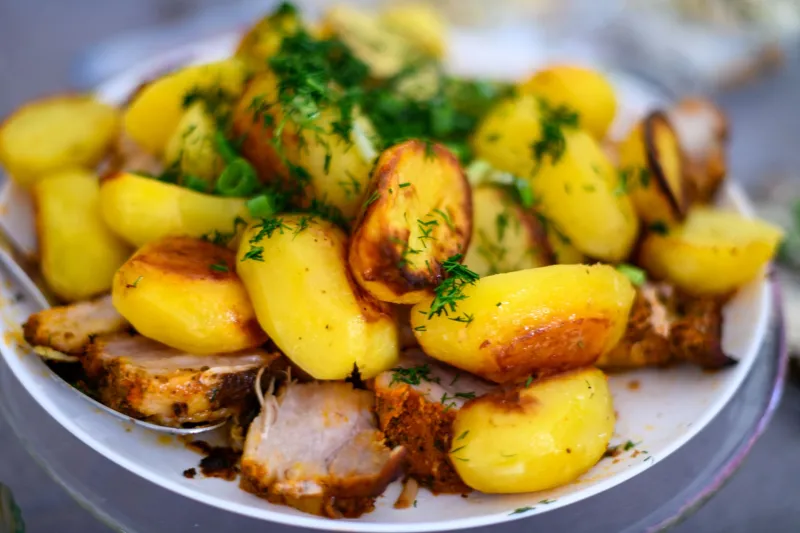
Amber (1994) is the mashed potato of the catalogue. This is not an insult. Mash is the component that makes a roast cohere: soft, rounded, buttery in the low end, with gentle peaks that absorb gravy without collapsing. Amber has exactly that quality. It is warm and approachable, but it is not plain, and it rewards the same attention you give to getting the butter ratio right. Roast potatoes are a different matter. Chiastic Slide (1997) is the tray of roasties that catches on the corners: irregular, crisp-edged, hot-fat loud, and all the better for it.
Greens, sauces and the bright cut: Oversteps and SIGN
Oversteps (2010) is mint sauce: sharp, bright, and useful for cutting through the fat. It is a side, not the main event, but the plate is worse without it. SIGN (2020) is redcurrant: sweeter, slower, more contemplative. If lamb is on the table, the mint-versus-redcurrant argument is already underway. In record terms, choose Oversteps when the meal needs a lift and SIGN when it needs a long exhale. Do not serve both at once unless you enjoy a plate that cannot decide what it is.
The long reduction: elseq and NTS Sessions
elseq 1–5 (2016) is the stock simmering down: long, incremental, transformative, and best when nobody is checking the clock. NTS Sessions 1–4 (2018) is the whole roast plus leftovers: sprawling, rewarding, and far too much for a single sitting unless the afternoon has genuinely opened up. Put NTS on after the plates are cleared. Play one session, not all four, unless the washing-up has been abandoned as a lost cause.
Washing-up and the second wind: Confield, Draft 7.30, Untilted and Exai
Confield (2001) is the washing-up: abrasive, necessary, and oddly satisfying once you stop resisting. Draft 7.30 (2003) is the drying rack: precise, clattery, and full of small mechanical decisions. Untilted (2005) is the last pan scrape: awkward, funky, and finished before you expect. Exai (2013) is the second helping you should not have but do: dense, generous, and best enjoyed standing up in the kitchen while the gravy boat is still out.
Regional variations: dripping, Lancashire and the sauce question
Beef dripping versus sunflower oil is a real fork in the road. Dripping is heavier and more savoury: think Tri Repetae or Exai. Sunflower oil is lighter and cleaner: think Oversteps or SIGN. Neither is correct. Match the fat to the record and the record to the fat.
The Yorkshire versus Lancashire debate is mostly about who gets to be right. In record terms, Yorkshire pudding's fast rise is Incunabula; Lancashire's slower, saucier register is Amber. If you go Lancashire, lean into the slower, layered approach and let elseq take the afternoon.
Mint sauce versus redcurrant is the sauce question in miniature. Mint is Oversteps: sharp and corrective. Redcurrant is SIGN: sweet and unhurried. If the meat is lamb, tradition points one way; if the plate needs soothing, the other.
Printable scorecard for fan debates
Print this, argue, do not @ me.
| Album | Roast component | Texture | Score /10 |
|---|---|---|---|
| Incunabula | Yorkshire pudding | Crisp, quick | 8 |
| Amber | Mashed potato | Soft, rounded | 9 |
| Tri Repetae | Beef joint | Dense, savoury | 9 |
| Chiastic Slide | Roast potatoes | Irregular, crisp | 8 |
| LP5 | Gravy | Reduced, glossy | 8 |
| Confield | Washing-up | Abrasive, necessary | 7 |
| Draft 7.30 | Drying rack | Precise, clattery | 7 |
| Untilted | Last pan scrape | Awkward, funky | 7 |
| Quaristice | Pickle tray | Sharp, varied | 7 |
| Oversteps | Mint sauce | Bright, cutting | 8 |
| Exai | Second helping | Dense, generous | 8 |
| elseq 1–5 | Slow stock | Long, incremental | 9 |
| NTS Sessions | Leftovers | Sprawling, rewarding | 8 |
| SIGN | Redcurrant | Sweet, slow | 8 |
| PLUS | Extra gravy boat | Companion, richer | 7 |
The last Yorkshire
The roast ends with tea and a stack of plates. Autechre's catalogue does not have to be a test. Use the running order, then break it. In 2026, with vinyl prices where they are and Sunday afternoons shorter than they should be, the least you can do is get the sequence right. Start with the oven. End with the washing-up. Let Amber be the mash.